AI Models · Lesson L01
What Is an AI Model Tier List? A Beginner's Guide to Comparing LLMs (2026)
Why 'best model' is the wrong question — and a 4-tier mental model that maps any workload to the cheapest model that will actually handle it.
Last tested and updated: June 2026
Dozens of AI models ship in 2026. Picking the wrong one costs you hours every week.
Most guides answer this with a leaderboard — a ranked list, S through D. Leaderboards are a starting point. They’re dangerous if you treat them as ground truth. The right question isn’t “which model is best?” but “which tier fits the work I’m actually doing?”
The hook
Pick a workload, not a model. The cheap one does a news summary 95% as well for 1/20th the cost.
Now a harder task: “Refactor the auth layer of my production app, write the migration, run the tests, fix anything that breaks.” The cheap one fails half the time. The expensive one succeeds 80% of the time. The tier gap is real. It’s not “model A is smarter” — it’s “more reliable on this specific shape of work.”
That’s the gap. The model that wins a leaderboard isn’t the model that wins your week. The work you do, the cost you absorb, and your “almost right” tolerance decide your tier.
The mental model
AI models exist in 4 tiers. Each tier is a different answer to a different question. This is not a leaderboard. It’s a routing chart for your workload.
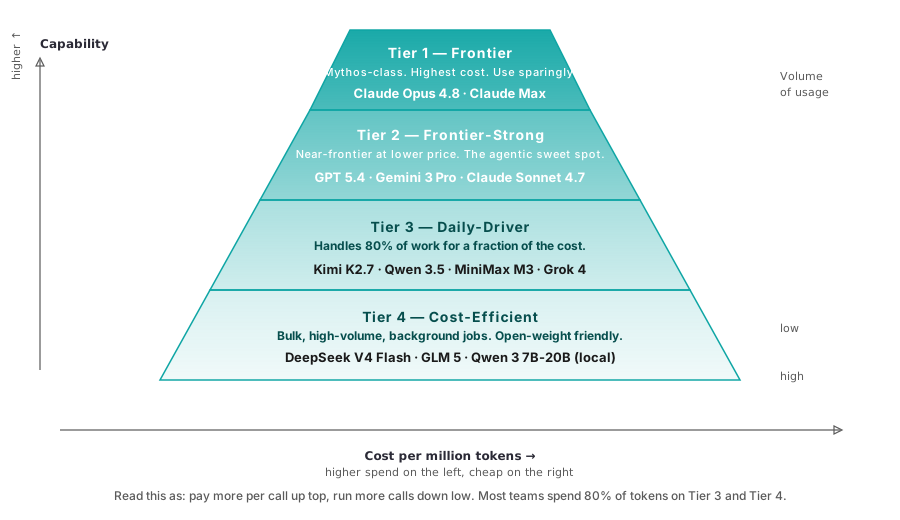
Tier 1 — Frontier. Claude Opus 4.8 and Claude Max. Mythos-class on hard reasoning. The most expensive models per token and the most capable on multi-step work. Use them when the task is genuinely hard and “almost right” is unacceptable.
Tier 2 — Frontier-Strong. GPT 5.4, Gemini 3 Pro, Claude Sonnet 4.7. Within a few points of Tier 1, often at a fraction of the cost. The agentic-coding sweet spot.
Tier 3 — Daily-Driver. Kimi K2.7, Qwen 3.5, MiniMax M3, Grok 4. Handles the 80% that isn’t hard — summarisation, drafting, Q&A, extraction, code review, meeting notes. Cheaper than Tier 2 by 3–10×. This is where you’ll spend the most tokens.
Tier 4 — Cost-Efficient. DeepSeek V4 Flash, GLM 5, and open-weight 7B-20B you can run locally. Bulk, high-volume, background jobs: translation, classification, extraction, batch summarisation. Also the fallback when you don’t want to send sensitive data to a frontier API.
“Best model” is a workload question, not a leaderboard question. Frontier models aren’t “smarter” than daily-driver models in any absolute sense. They’re tuned for a different shape of problem. The mistake is paying frontier prices for daily-driver work, or running critical work on cost-efficient models and wondering why it fails.
Pick your tool
Pick by cost of being wrong. High cost of being wrong → go up a tier. Low cost of being wrong → go down. Most users run Tier 3 daily, Tier 1 or 2 for hard stuff, Tier 4 in the background. Here’s a rough mapping from workload to tier:
| Workload | Pick | Why |
|---|---|---|
| Multi-day research synthesis, novel architecture decisions | Tier 1 (Opus 4.8, Claude Max) | Needs depth, long-context retention, willingness to pay $20+ per task. |
| Hard agentic coding, complex refactors, multi-file migrations | Tier 2 (Sonnet 4.7, GPT 5.4, Gemini 3 Pro) | Near-frontier at 1/3 to 1/5 the cost. Agentic-coding sweet spot. |
| Daily Q&A, drafting, code review, meeting notes | Tier 3 (Kimi K2.7, Qwen 3.5, MiniMax M3) | Handles 80% of work for a fraction of the cost. See L03 — Chinese Open-Weight Models. |
| Bulk extraction, translation, classification, batch jobs, or privacy-sensitive data you don’t want leaving your laptop | Tier 4 (DeepSeek V4 Flash, GLM 5, local 7B-20B) | Designed for volume or local-only runs. Quality is “good enough,” not “frontier.” See L04 — Cost-Efficient Tier. |
For a deeper comparison once you’ve tried the tiers, see L05 — Frontier vs Open-Weight: Decision Framework. For the Anthropic family specifically, L02 — The Anthropic Family walks through Opus, Sonnet, and the rest of the lineup.
Try it
The exercise
Open a text file. Write down the answer to this in your own words, no copy-paste:
“Pick three tasks you do every week. For each one, name the tier it belongs to and one model from that tier. Then estimate how many tokens per week that tier costs you at current pricing.”
A good answer names a tier per task, a specific model per tier, and a rough token count.
A worked example
See L01 example — routing three workloads to three tiers for a full workload × tier × model × cost walkthrough.
Check your understanding
Quiz: see quiz.json (6 questions, valid JSON).