Release brief · July 23, 2026
White House says Kimi K3 stole Claude, but AI was built on everyone else's work
Washington says Moonshot distilled Fable 5 into Kimi K3. The backlash asks why learning from a model is theft when AI learns from everyone.
The accusation is serious, not self-proving. Anthropic documented a large Moonshot extraction campaign, but the White House has not publicly connected it to Fable 5 or Kimi K3. U.S. labs also train on contested human work and routinely distill models; the real dispute is who gets permission to learn from whom.
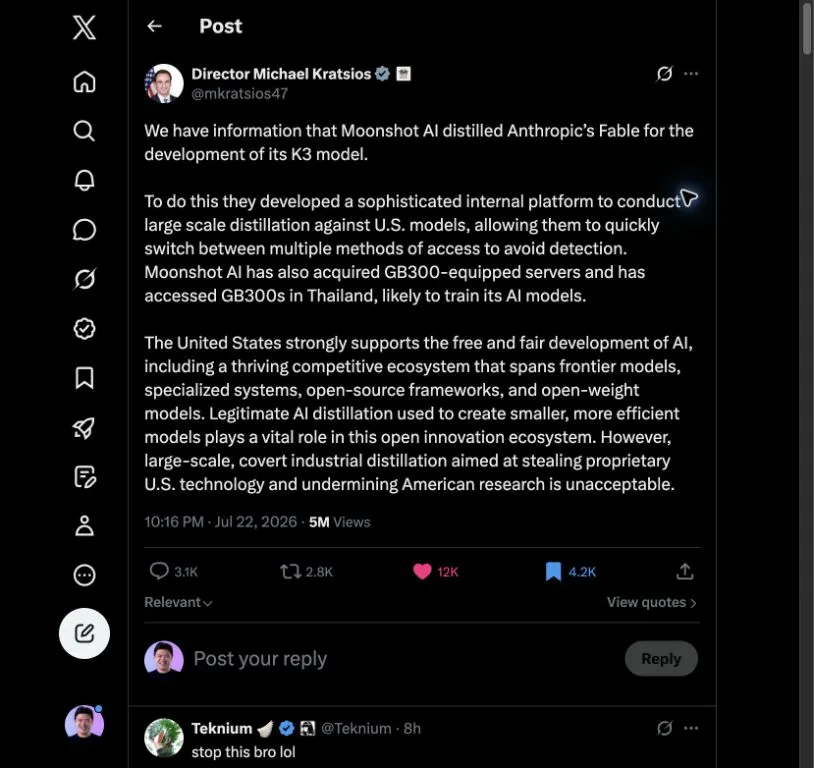
The White House made a serious public accusation: Moonshot AI built Kimi K3 by secretly extracting capabilities from Anthropic’s Claude Fable model.
Michael Kratsios, the White House science and technology adviser and director of the Office of Science and Technology Policy, said on X that the Chinese lab created an internal platform for large-scale distillation, switched between access methods to evade detection, and obtained or accessed Nvidia GB300 systems, including in Thailand.
Kratsios called legitimate distillation an important part of AI development. His line was that covert, industrial-scale distillation of a rival’s proprietary model crosses from normal research into theft.
The State Department quickly escalated that language. Under Secretary of State Jacob Helberg called the alleged operation more than a theft of American intellectual property. He described it as an assault on economies built around entrepreneurship and private capital, adding that “lying, cheating, and stealing” should not be confused with innovation.
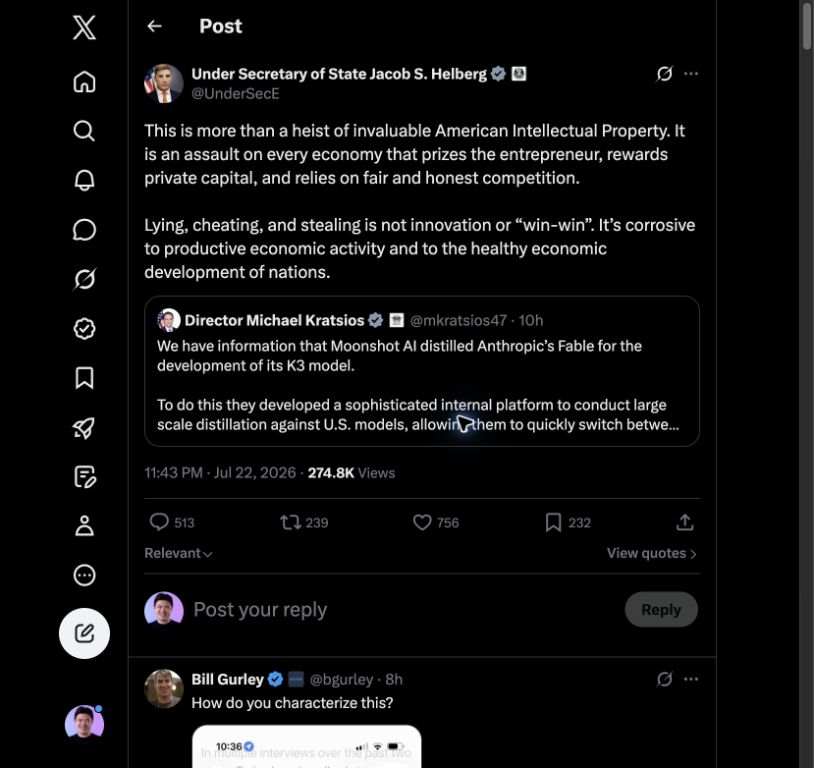
Helberg’s amplification matters: the “heist” framing is now coming from both the White House science office and a senior State Department official.
That distinction is the administration’s case. The post offered no logs, account records, technical fingerprints, dates, or model-behavior analysis tying Fable 5 specifically to Kimi K3. One of Washington’s strongest AI accusations of the year therefore asked the public to trust the government without seeing its evidence.
The community did not buy the presentation
The visible response beneath Kratsios’s post is brutal.
Teknium answered, “stop this bro lol.” Erik Voorhees reduced the alleged industrial espionage to a “Terms of Service violation.” Matthew Graham said nobody who could read would believe it.
The most popular replies attacked the moral framing. Haider inverted Kratsios’s wording, saying Anthropic had distilled “humanity’s entire internet” into Fable 5. Yacine pointed to Anthropic’s use of public GitHub code and online writing. Thomas Unise made the same argument on behalf of independent publishers.

A sample of visible replies on July 23. It shows the tone of the reaction, not a scientific poll of the AI community.
Even the sharper jokes are making two serious arguments:
- Show the evidence. “We have information” is not the same thing as publishing verifiable proof.
- Explain the double standard. U.S. frontier labs trained on enormous amounts of human-created material, often without individual permission, then claimed a proprietary boundary around the resulting model outputs.
That second point is politically potent, and it cuts deeper than ordinary whataboutism. The modern AI stack was built by absorbing human knowledge at enormous scale. The same companies now want to draw a hard proprietary line around what their models learned from it.
Everyone learns from everyone
“Everybody steals from everybody” is crude, but it captures the recursive reality of AI development.
Foundation models learn patterns from books, journalism, websites, art, software repositories, forums, photographs, and other human work. Newer systems also learn from synthetic examples generated by older models. Researchers use stronger models to label data, generate instructions, critique answers, score preferences, and teach smaller models. The outputs then become inputs for the next training run.
Distillation is not a Chinese loophole. OpenAI sells an integrated distillation workflow that lets developers capture outputs from frontier models and use them to fine-tune cheaper ones. Stanford’s influential Alpaca project trained a Llama model on 52,000 instruction-following examples generated by OpenAI’s text-davinci-003. Anthropic itself says legitimate distillation is routinely used across frontier labs.
The fight is therefore not over whether models should learn from models. They already do. It is over authorization, scale, concealment, and competition. A lab calls the process innovation when it distills its own model or permits a customer to do it inside its platform. It calls the same underlying technique theft when a rival allegedly uses fraudulent accounts, breaks access restrictions, and builds a competing frontier system.
That distinction can matter legally and commercially. It is also convenient for the companies defining it.
Anthropic’s own copyright reckoning landed one day earlier
The timing sharpened the backlash. On July 21, a federal judge approved Anthropic’s $1.5 billion settlement with authors whose books had been acquired from pirate libraries and used in the Claude training pipeline, the Associated Press reported.
The underlying court decision was mixed: training on lawfully acquired books was found to be fair use, while building a permanent library from millions of pirated books was not protected. Anthropic emphasizes the first half. Authors understandably emphasize the second and the money.
OpenAI and Microsoft, meanwhile, are still fighting The New York Times over the alleged use and reproduction of its journalism. Artists, publishers, music companies, authors, and software developers have brought other cases across the industry. The U.S. Copyright Office has devoted an entire report on generative-AI training to a question the market has not settled: when does machine learning from a protected work become infringement, and when is it fair use?
This is why the moral certainty in Washington’s language falls flat. American AI companies are asking courts and the public to accept that mass ingestion of human work can be transformative learning, while model-on-model learning becomes “stealing proprietary U.S. technology” when the learner is a Chinese competitor.
There may be a valid boundary there. The government has not explained it convincingly yet.
Pretraining on a huge corpus is not technically identical to systematically querying one target model for high-value reasoning traces, tool-use behavior, or synthetic training examples. Nor does one unresolved copyright fight excuse fraudulent accounts or access evasion in another. But both disputes revolve around the same uncomfortable act: taking intelligence produced elsewhere, transforming it at scale, and claiming the result as a new proprietary system.
There is more behind the allegation than one tweet
The strongest support for Kratsios’s accusation comes from Anthropic’s earlier investigation, not from the White House post itself.
In February, Anthropic said it had detected industrial-scale extraction campaigns run by DeepSeek, Moonshot, and MiniMax. Across the three labs, Anthropic counted more than 16 million Claude exchanges through roughly 24,000 allegedly fraudulent accounts.
Anthropic attributed more than 3.4 million exchanges to Moonshot. It said hundreds of accounts accessed Claude through multiple pathways and targeted agentic reasoning, coding, data analysis, computer use, and computer vision. The company also claimed that request metadata matched public profiles of senior Moonshot staff and that later activity attempted to reconstruct Claude reasoning traces.
That is substantially more detailed than a political talking point. It describes scale, targets, access patterns, and an attribution method.
But it still leaves a crucial public gap. Anthropic’s February report described a campaign against Claude models generally. Kratsios’s July post made the newer, more specific leap: Fable outputs were used to develop K3. Neither Kratsios nor Anthropic has publicly released the evidence chain for that model-to-model connection.
The two claims may ultimately be supported by the same investigation. Today, the public cannot verify that from the material provided.
The 37-day timeline is suspicious, but it does not settle the question
Fable 5 launched on June 9. Moonshot unveiled Kimi K3 on July 16. That narrow window is driving much of the skepticism: a 2.8-trillion-parameter model with a million-token context window was plainly not pretrained from scratch in 37 days.
But the timing does not disprove distillation. A base model can be trained long before release and then improved during post-training with synthetic examples, preference data, tool-use traces, or targeted demonstrations. Kratsios did not claim that every K3 weight came from Fable; he claimed Fable was distilled “for the development” of K3.
The honest conclusion is narrower: the dates make a simplistic “K3 is a copy of Fable” story implausible. They do not rule out a late-stage capability-transfer campaign.
Moonshot’s public K3 material does not answer the accusation
Moonshot presents Kimi K3 as a 2.8-trillion-parameter, natively multimodal, million-context model built for long-horizon coding and knowledge work. Its launch material discloses benchmark settings and limitations, and says a fuller technical report will provide more architecture and training detail.
The launch post does not disclose Fable-generated training data or directly address Kratsios’s allegation. As of publication, we could not find a public Moonshot response to the July 22 accusation.
K3’s impact is not imaginary. The Associated Press reported that it reached the top of Arena’s front-end coding ranking, while Moonshot’s own evaluations place it near the proprietary frontier on several coding and agentic tests. Those results are the reason this argument matters: K3 is not being dismissed as a minor imitation. It is being treated as a strategic threat.
Why Washington is escalating now
The accusation joins two U.S. policy fights that are rapidly merging.
The first is model access. American labs want stronger controls on proxy accounts and resellers that can turn a consumer or API product into an industrial synthetic-data pipeline.
The second is compute access. Kratsios separately alleged that Moonshot acquired GB300-equipped servers and accessed GB300 systems in Thailand. That hardware claim was not substantiated in the post either, but it points directly at U.S. export-control enforcement and the use of third countries to reach restricted chips.
Treasury Secretary Scott Bessent has said the administration is examining Chinese models for stolen U.S. intellectual property and considering sanctions, according to Axios. Nvidia CEO Jensen Huang pushed the other way, arguing that open Chinese models expand the AI market and that learning from other systems is fundamental to intelligence.
The thread matters because Washington is trying to establish a political category called industrial AI theft. Developers hear a closed-model company complain that somebody learned from its outputs after the same industry learned from everybody else’s work.
If the administration wants that category to hold, it needs a public standard more persuasive than nationality plus benchmark proximity.
Our view: the mockery finds the weak spot, not the verdict
The community is right about the burden of proof. A White House official cannot turn an allegation into an established fact by saying “we have information,” especially when the claim could support sanctions, chip controls, or bans on foreign models.
The community is also too quick when it treats the absence of published evidence as proof that no extraction happened. Anthropic’s February disclosure is specific enough that it cannot be waved away as pure coping. Millions of exchanges, hundreds of accounts, multiple access paths, and attributed metadata describe a real investigation that deserves a real response from Moonshot.
The fair headline is neither “Kimi K3 was stolen” nor “the White House invented the whole thing”:
The U.S. government has escalated a documented pattern of suspected Moonshot extraction into a specific accusation about K3, without publishing the evidence needed to verify that final step.
The laughter is a warning that “trust us” no longer works in an AI industry already fighting over who was allowed to learn from whom.
Sources
- Michael Kratsios: Kimi K3 distillation accusation
- Jacob Helberg: The alleged distillation was an IP “heist”
- Anthropic: Detecting and preventing distillation attacks
- OpenAI: Model Distillation in the API
- Stanford CRFM: Alpaca’s 52,000 synthetic instruction examples
- Associated Press: Anthropic’s $1.5 billion authors settlement
- U.S. Copyright Office: Copyright and Artificial Intelligence
- Moonshot AI: Kimi K3 technical launch post
- Associated Press: Kimi K3 catches up to U.S. frontier models
- Axios: Jensen Huang rejects the Kimi panic
- South China Morning Post: Kratsios did not publicly present the Fable-to-K3 evidence